🏠How to Make Your Home More Restorative.
A PRISM Guide to Creating a Home That Gives Something Back
Your home doesn't have to be perfect to be restorative. ✨
You can love your home and still feel tired by it. Sometimes the problem isn't that your house is ugly, cluttered, or poorly designed. It's that almost every room is quietly asking something from you.
The kitchen reminds you what needs cleaning. The desk reminds you what you haven't finished. A pile of mail is waiting for a decision. Your phone is charging beside the bed. The laundry is visible. A project you meant to finish three months ago is still sitting in the corner.
Your home may be comfortable without actually being restorative.
🌿 What Is a Restorative Home?
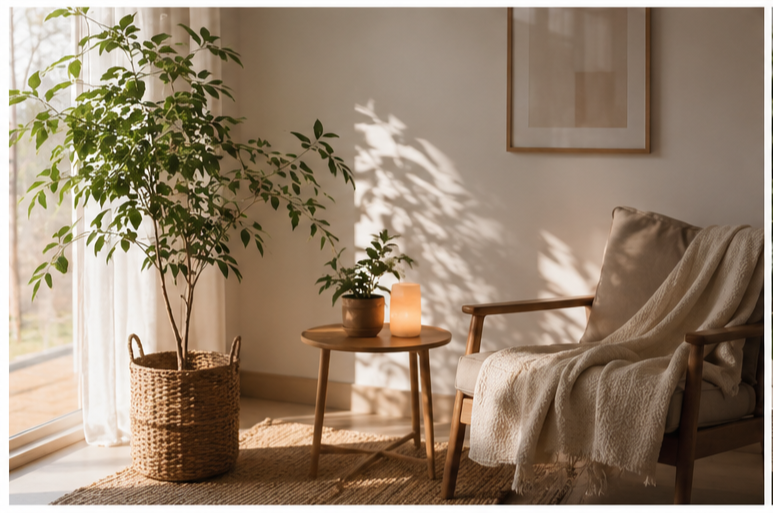
A restorative home is an environment that helps you recover from the demands of everyday life. It reduces unnecessary friction, gives your attention somewhere pleasant to land, supports the behaviors you want, and creates room for both solitude and connection.
It doesn't require a renovation. It doesn't require expensive furniture. And it definitely doesn't require buying a houseful of products labeled 'wellness.'
A useful way to think about it is through five jobs your home can do:
Reduce. Reduce visual and mental noise.
Recover. Help you transition out of work, activity, and stimulation.
Restore. Give your senses something pleasant and natural to experience.
Support. Make the behaviors you value easier.
Reconnect. Make it easier to spend meaningful time with the people you care about. 🤝
1. 👀 Notice What Is Constantly Asking for Your Attention
Not everything visible is clutter. Some things are simply unfinished decisions.
· A stack of mail you haven't opened.
· A counter covered with appliances you rarely use.
· A basket of laundry that never quite disappears.
· A project waiting for you to decide what to do with it.
· A room that has become a storage area by accident.
The point isn't to become a minimalist. The point is to notice how many small visual cues your brain is processing when you are supposed to be resting.
Try this: choose one room and remove five things that create unnecessary visual noise. You don't need to reorganize the entire room. Just lower the number of things asking for your attention.
2. 🌙 Give Yourself a Transition
Modern life often has terrible transitions. Work ends and you're immediately home. Dinner ends and you're immediately answering messages. The day ends and your phone comes into bed with you.
Your environment can help mark the change from one state to another.
· Change clothes when you get home.
· Put your phone in a consistent place for the evening.
· Turn on lamps instead of overhead lights. 🕯️
· Open a window or step outside. 🌿
· Make tea.
· Take five quiet minutes before beginning the next thing.
The specific ritual matters less than the signal: we're doing something different now.
3. 🪴 Give Your Eyes Somewhere Beautiful to Rest
A restorative home doesn't need more decoration. It may need better visual destinations.
When you sit down, what do you see? A television? A pile of paperwork? A blank wall? Or something that makes you feel good?
· A window or view. ☀️
· A plant.
· A piece of art you actually love.
· A lamp with warm, comfortable light.
· A collection of meaningful objects.
· A view into a garden or outdoor space. 🌿
You don't necessarily need to buy anything. Sometimes the most restorative change is moving something you already love to a place where you will actually see it.
4. ✨ Make the Behaviors You Want Easier
Your environment is quietly shaping your behavior all day long.
· Want to drink more water? Put the glass or bottle where you naturally sit.
· Want to read? Put the book where you unwind instead of on a shelf. 📖
· Want to eat better? Make the foods you want to eat visible and easy to reach.
· Want to stretch? Keep the mat accessible instead of hidden in a closet.
· Want to spend less time on your phone? Give it a home outside your most restorative spaces.
This isn't about willpower. It's about reducing the number of decisions required to do something you already want to do.
5. 🪑 Create One Place Where You Don't Have to Accomplish Anything
This might be a chair, a porch, a garden bench, a corner of the bedroom, or a spot by a window.
The important part is that it isn't secretly another productivity station.
Don't answer email there. Don't make it the place where you sort paperwork. Don't turn it into your 'planning corner.'
Give yourself somewhere to sit without needing to accomplish anything.
6. 🌿 Pay Attention to the Sensory Environment
Restoration is physical. Notice what your senses experience at home.
· Light: Is it harsh when you want to settle down?
· Sound: Is there constant background noise?
· Temperature: Are you always too hot or too cold?
· Texture: Does the room feel comfortable or sterile?
· Smell: Are there persistent odors you have learned to ignore?
· Air: Does the room feel fresh?
· Nature: Is there anything living, changing, or natural for your eyes to rest on?
You don't need to solve all seven. Pick the one sensory irritant you notice most often and address that first.
7. 🌙 Let the Bedroom Do One Job Well
A bedroom doesn't have to be luxurious. It needs to be supportive.
· Reduce visual clutter.
· Make the lighting comfortable.
· Keep work materials from dominating the room when possible.
· Consider where your phone lives overnight.
· Pay attention to noise and temperature.
· Make the bed and bedding feel genuinely inviting.
The goal is fewer competing signals. Your bedroom should make it easier to recognize that the day is winding down.
8. 🤝 Remember That Restoration Can Include Other People
Restoration isn't always solitude. Sometimes the thing that gives you energy back is dinner with someone you love, a conversation at the kitchen table, a game, a cup of coffee on the porch, or having friends over.
Ask whether your home makes connection easy.
· Is there somewhere comfortable to sit and talk?
· Can people gather without a screen automatically becoming the center of the room?
· Is eating together easy?
· Is there an outdoor place where people naturally want to linger? 🌿
✨ The Five-Minute Restorative Home Audit
Walk through your home and ask six questions about each room:
· RESTORE — Does this room make me feel better after spending time here?
· FRICTION — What repeatedly annoys me?
· NOISE — What constantly asks for my attention?
· SUPPORT — What behavior could this room make easier?
· BEAUTY — What do I actually enjoy looking at?
· CONNECTION — Does this space encourage people to be together?
Then choose one change. Not twelve. One.
🏡 You Don't Need a Perfect Home
A restorative home isn't a magazine spread. It isn't a minimalist showroom. And it isn't a collection of expensive wellness products.
It is simply a home that gives something back to you.
It reduces a little friction. It quiets a little noise. It makes something you value easier. It gives you somewhere beautiful to look. And sometimes, it gives you permission to do absolutely nothing.
📖 Want to Actually Do This in Your Own Home?
The PRISM Restorative Home Guide turns these ideas into a room-by-room audit, prioritization exercises, sensory checklist, healthy-habit prompts, and a seven-day reset you can actually complete.
The Restorative Home Guide — $4.44✨
A small, practical download for turning the idea of a restorative home into a plan. 🌿